
Early in building Lumenas, we found ourselves often reading job advertisements for IT Managers. Not because we were hiring, but because job ads are a frank assessment of what an organisation thinks a role involves. This helps us better understand the misunderstanding of IT roles, and how persistent these issues may be, which helps us better design our products which help close this gap.
Looking at job ads helped us check whether anecdotal experiences were more systematic. Do organisations persistently misunderstand what IT leaders do? We expected this would probably be the case, but we were struck by the consistency.
The most consistent gap we noticed was the near-total absence of governance. The technical requirements were detailed, but the leadership and management expectations were vague. Based on the job descriptions we looked at, you would expect people in these roles to be tactically proficient, highly responsive but rarely proactive.
We know this isn’t an accurate depiction of what IT leadership requires, or looks like, in reality. This gap in the perception and reality of IT leadership is probably shaped by a number of factors. One factor that seemed worth better understanding was the role of pop culture.
Pop culture significantly shapes our perceptions of careers. Perhaps most famously, the release of the original Top Gun move inspired a nearly 10% increase in US Navy recruitment. The portrayal of particular occupations shapes our expectations about jobs and the people in them.
To better understand how Western pop culture has shaped our perceptions of IT careers we decided to start a weekly series in which we’d analyse iconic IT characters.
Six weeks, six characters, five questions
We spent six weeks analysing fictional IT managers to better understand how pop culture portrays the role and how those portrayals might be shaping the expectations of the people who hire, manage, and work alongside IT leaders.
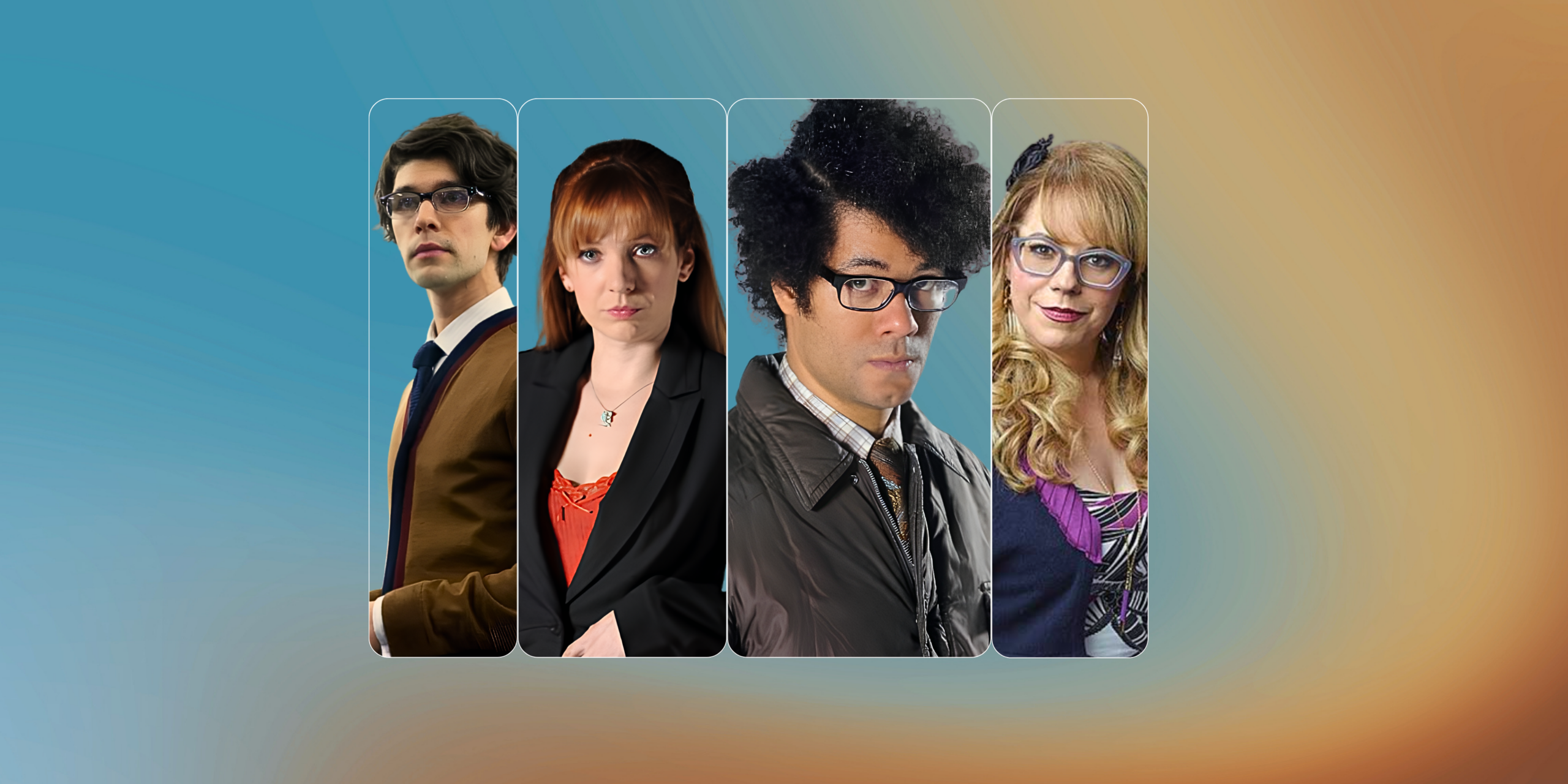
We chose six characters: Moss and Jen from The IT Crowd, Gilfoyle from Silicon Valley, Abby from NCIS, Penelope Garcia from Criminal Minds, and Q from the James Bond franchise. We asked the same five questions of each character.
Is this character a punchline or a person? We wanted to know whether the show treated its IT character as a fully realised human being, or as a recurring joke. The distinction matters: a character who exists to be laughed at teaches the audience something different about IT than one who is shown to have depth, growth, and genuine relationships.
Is this a realistic portrayal of IT leadership? Not technically accurate (we weren’t looking for accurate depictions of network architecture) but realistic in terms of what IT leadership actually involves. Does the character deal with stakeholders? Manage ambiguity? Operate under constraints? Or does technology simply work like magic whenever the plot requires it?
What cultural value does this place on IT? Is IT work portrayed as cool, respected, and consequential? Or as something slightly embarrassing; tolerated rather than valued? This question gets at the status the show implicitly assigns to the role.
How mature is this character’s IT leadership? Are they reactive – fixing things when they break – or are they building systems, developing people, and shaping the direction of their organisation? We scored this on a spectrum from firefighting to force-multiplying.
How likely are they to adopt Lumenas? We included this partly for marketing purposes but also because it forced us to think concretely about each character’s relationship with management tools. If presented with a tool that would require you to actively opt into thinking strategically about the business of IT, would you welcome it? Or shun it?
Asking the same five questions across six characters gave us a simple basis for comparison, and pushed us to think about each character in more depth than we had as fans. This helped us learn a few things upon observation and even more upon reflection.
What we learned
The Peter Pan problem
Almost every fictional IT character is frozen in time.
Moss never learns to navigate the world outside his server room. Penelope delivers results at impossible speed across fifteen seasons but never builds a team or a system that could outlast her. Abby is the most competent person in the building, but the show never gives her adequate resources or support. Gilfoyle refuses to manage anyone and is rewarded for it. Q equips Bond and disappears. Jen tries to grow and is consistently humiliated for the attempt.
In fiction, IT characters don’t grow up. The comedy, the drama, the narrative tension; it all depends on them staying exactly as they are.
We called this the Peter Pan problem.
The parent-child paradox
There’s a second pattern that runs alongside the first, and it’s a weird twist.
These characters are simultaneously infantilised and expected to parent everyone around them. They’re treated as oddities — socially awkward, professionally misunderstood, never quite taken seriously. But they are also the person everyone calls when something goes wrong. They’re there to fix it. Without complaint or explanation. They rarely ask for more time, resources or even information.
The message, repeated across decades of television, is that IT leaders will always be there to save us. Not just because they’re capable — but because that’s ‘who’ they are.
That’s an impossible bar. No one can always give. And when the expectation is that IT leaders exist to absorb problems without limit, the question that never gets asked is: what do they need to succeed?
Who came out on top
When we scored the six characters across the first four questions — leaving aside the Lumenas adoption question — Q scored highest. He’s the most realistic portrayal, the most force-multiplying, and the only character in the series who is consistently treated as a peer rather than a curiosity.
Remove question 5 on Lumenas adoption and Gilfoyle wins. He’s the most accurate portrayal of what real infrastructure work looks like, and the show respects him for it.
Moss scored lowest by a significant margin. Almost every question landed him at the bottom of the scale. But we also learnt from our posts on Linkedin that Moss is the People’s Choice with the most likes of any character. Looking beyond likes, to see who had the highest engagement, we found that Penelope and Jen tied as the most intriguing of IT characters. More than half of everyone who saw those posts clicked through to read more.
The contrast between the highest score and most likes taught us something important about the IT community. Technical excellence earns admiration, but genuine effort and good intent earns different kind of trust. No one thinks Moss is a good example of IT leadership, but we love him anyway. It’s hard to think of another profession where capability is so highly valued but honest effort is wholeheartedly prized.
We hope you enjoyed this series as much as we did. It changed how we think about the gap between what IT leaders are expected to be and what they’re given to work with in most jobs.